

Description
The DJI AP1 Parachute with Matrice 5TD Series Accessory Mount is an emergency recovery system designed for the DJI Matrice 5TD aircraft and DJI Dock 4 ecosystem. Integrating with the aircraft's Flight Termination System (FTS), the parachute provides an additional safety mechanism to help reduce ground impact risks during emergency situations.
Designed to support advanced drone operations, including Beyond Visual Line of Sight (BVLOS) missions where authorised, the lightweight AP1 Parachute combines automatic and manual deployment capabilities with continuous system monitoring.
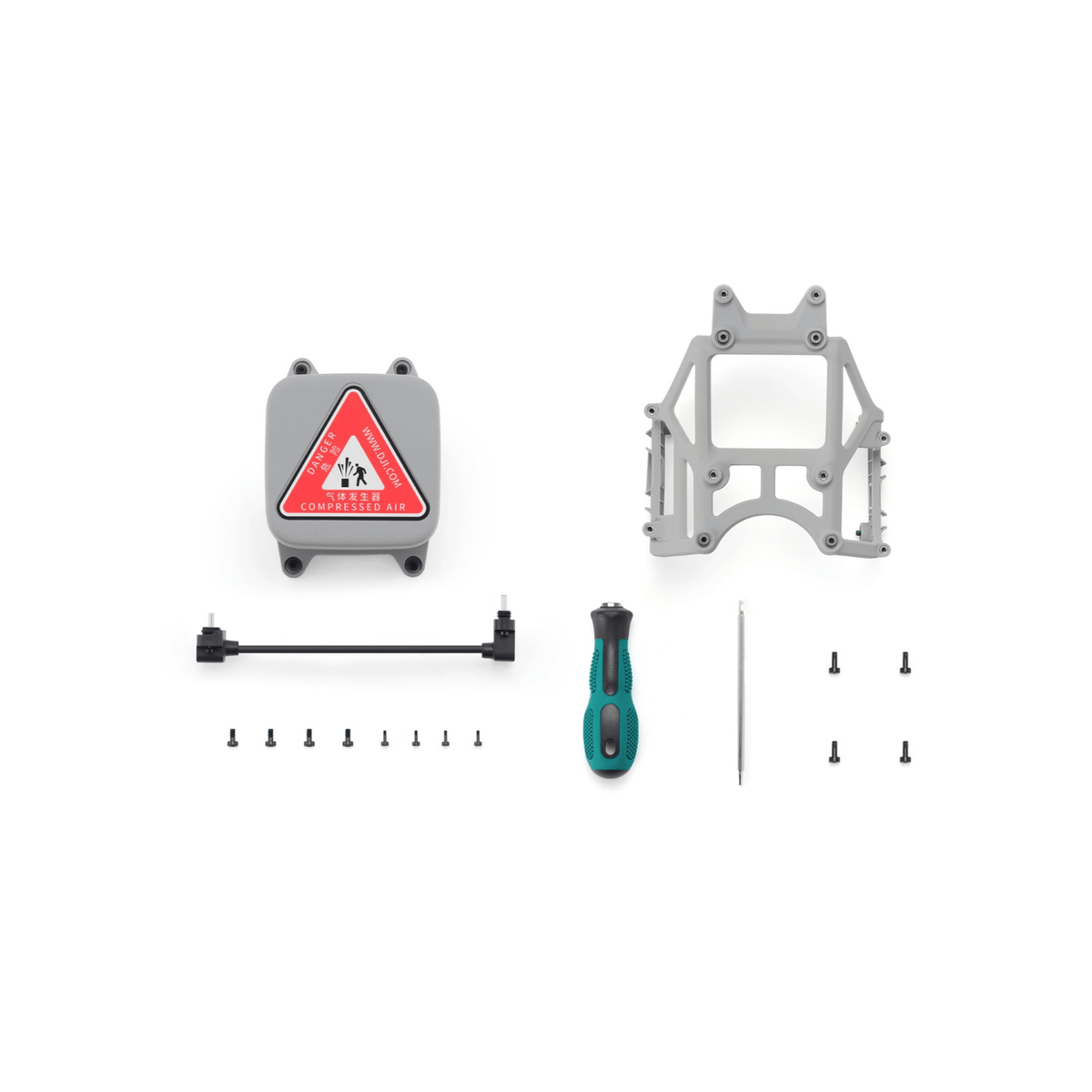
The included Matrice 5TD Series Accessory Mount provides three mounting positions, allowing the parachute to be installed alongside compatible DJI lighting and broadcasting accessories.
Key Features
-
Automatic and Manual Deployment: Supports automatic and manual parachute activation, including integration with the aircraft's Flight Termination System.
-
Rapid FTS Response: A 600 ms response interval, measured from FTS activation through rotor shutdown to the gas generator's electrical trigger signal under controlled testing conditions.
-
Lightweight Design: The parachute weighs 107 g, with a combined parachute and accessory mount weight of 147 g.
-
Controlled Emergency Descent: Designed to achieve a stabilised descent speed below 6 m/s under specified operating conditions.
-
Continuous System Monitoring: Automatically monitors gas generator and communication link status, with alerts displayed through DJI FlightHub 2 Health Management System (HMS).
-
Independent FTS Link: Supports an independent Flight Termination System connection.
-
Multi-Accessory Mounting: Three mounting positions accommodate the AP1 Parachute, DJI AL2D Spotlight and DJI AS2D Loudspeaker.
-
IP55 Protection: Designed to operate in temperatures ranging from −40°C to 50°C.
Specifications
DJI AP1 Parachute
| Specification | Details |
|---|---|
| Weight | 107 g (excluding mounting bracket) |
| Dimensions (L × W × H) | 92 × 70 × 56 mm (excluding bracket) |
| Maximum Supported Takeoff Weight | 3,050 g |
| Operating Altitude | 0–5,000 m |
| Stabilised Descent Speed | Less than 6 m/s |
| Minimum Effective Deployment Altitude | 35 m above ground |
| Automatic Deployment Response Time | 600 ms |
| Deployment Method | Manual / Automatic |
| Operating Temperature | −40°C to 50°C |
| Ingress Protection Rating | IP55 |
| Mounting Position | Top of aircraft using Matrice 5TD Accessory Mount |
| Audible and Visual Alerts | Aircraft beeping and indicator flashing |
| Backup Power Duration | 30 seconds |
| Self-Check | Continuous monitoring of gas generator and communication links |
| System Monitoring | DJI FlightHub 2 HMS |
| Independent FTS Link | Supported |
DJI Matrice 5TD Series Accessory Mount
| Specification | Details |
|---|---|
| Weight | 40 g |
| Dimensions (L × W × H) | 117 × 126 × 70 mm |
| Number of Mounting Positions | 3 |
| Top Mount | DJI AP1 Parachute |
| Left Mount | DJI AS2D Loudspeaker |
| Right Mount | DJI AL2D Spotlight |
| Compatible Aircraft | DJI Matrice 5TD |
What's in the Box
-
DJI AP1 Parachute × 1
-
DJI Matrice 5TD Series Accessory Mount × 1
Important Operational Information
Deployment Altitude: The minimum effective deployment altitude is 35 m. Below this height, the parachute may deploy without fully inflating or adequately reducing descent speed. Automatic deployment may also fail to trigger in some circumstances, requiring manual operation.
Deployment Response: The 600 ms figure represents the measured FTS response sequence, not the time required for complete parachute inflation.
Descent Performance: The stabilised descent speed of less than 6 m/s was measured in windless conditions at 25°C, between 30 m and 500 m altitude, with the Matrice 5TD operating at a takeoff weight of 3,050 g.
Installation: The AP1 Parachute mounts on top of the aircraft using the Matrice 5TD Accessory Mount. Mounting screws must be securely tightened during installation.
Flight Safety: The parachute is an additional emergency recovery system and does not eliminate operational risks or independently authorise BVLOS flights.
Specifications are based on DJI testing. Actual performance may vary depending on environmental conditions, aircraft configuration, usage and firmware version.